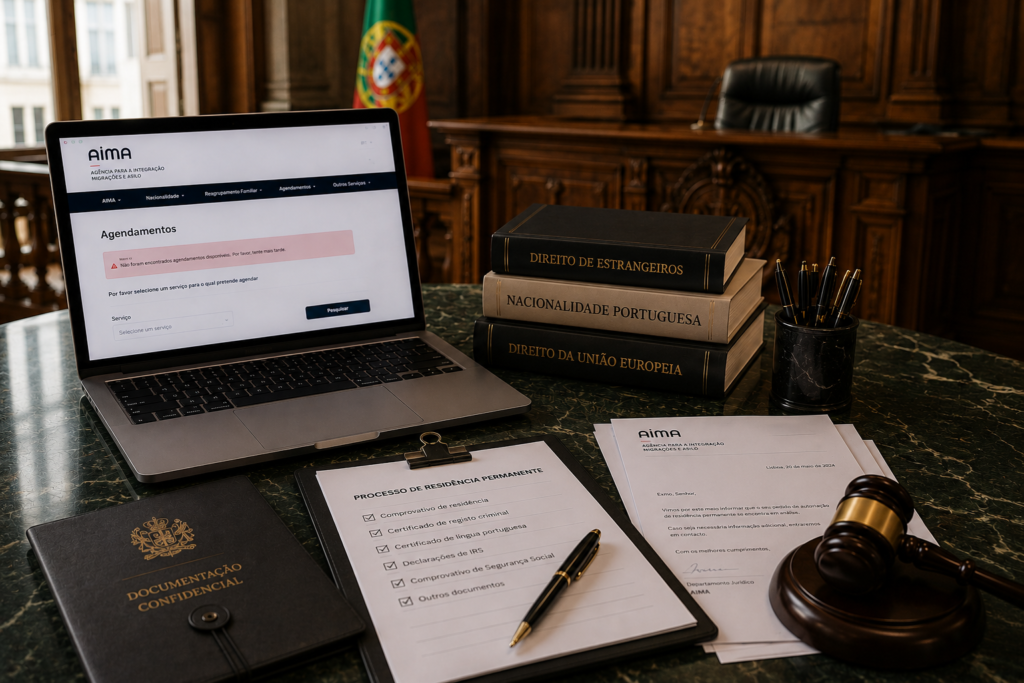
Many foreign residents in Portugal reach the five-year residence mark and believe they are ready to apply for AIMA Permanent Residency. In theory, the law provides a clear path. In practice, however, many applicants face the same obstacle: they cannot obtain an appointment with AIMA.
This creates a difficult situation. The person may meet the legal requirements, have lived in Portugal for years, paid taxes, built a family, maintained employment or business activity, and still be unable to submit the application because no appointment is made available.
The question is therefore clear:
“If AIMA does not open appointments for permanent residency, can you go to court?“
In some cases, yes.
Why AIMA Permanent Residency Applications Get Stuck
Portuguese immigration law provides for permanent residency when the legal requirements are met. However, the existence of a legal right does not always mean the process works smoothly in practice.
If the Administration does not provide an appointment or does not create an effective way for the applicant to submit the request, the person may be prevented from exercising a right provided by law.
This is where judicial action may become relevant.
The purpose of going to court is not to skip the line or obtain automatic approval. The purpose is to require the Administration to act, receive the application, or provide an appointment when the applicant has a legitimate legal interest and the administrative route is blocked.
When Can You Sue AIMA for Permanent Residency Delays?
Court action may be considered when there is a persistent administrative omission.
This may happen when:
- The applicant has held temporary residence for at least five years;
- The applicant appears to meet the legal requirements for permanent residency;
- AIMA does not provide appointments for this type of request;
- The applicant has tried to contact AIMA through available channels;
- The lack of an appointment is preventing the applicant from exercising a legal right;
- The situation is causing legal insecurity, repeated renewals, professional difficulties, or family disruption.
Applicants seeking AIMA Permanent Residency often discover that meeting the legal requirements is not enough when appointments remain unavailable.
Each case must be analysed individually. A lawsuit should not be filed blindly. It must be based on documents, evidence of eligibility, and proof that administrative attempts were made.
Evidence Needed Before Taking Legal Action
Before considering judicial action, it is important to create a clear documentary record.
This may include:
- Copy of current and previous residence permits;
- Proof of five years of legal residence;
- Passport copies;
- Proof of address;
- Tax returns or tax certificates;
- Social Security contribution records, where applicable;
- Criminal record certificates, where applicable;
- Portuguese language certificate, when required;
- Emails or contact forms sent to AIMA;
- Screenshots of failed appointment attempts;
- Proof of unanswered requests;
- Any AIMA communications received.
The stronger the documentary record, the stronger the legal strategy.
What Can a Portuguese Court Do?
A court action in this context normally seeks to address administrative inaction. The specific request depends on the facts of the case and the legal route chosen.
In practical terms, the goal may be to obtain an appointment, require AIMA to accept the application, or compel the Administration to perform the legally required administrative act.
It is important to clarify that the court does not usually replace AIMA in the substantive analysis of the permanent residency application. AIMA may still review the documents and assess whether the legal requirements are met.
The judicial route is mainly used to unlock the administrative process.
Is Court Action Always Recommended?
No.
There are situations where the applicant is not yet eligible, where documents are incomplete, where the residence history has gaps, or where a prior administrative step is still advisable.
Before going to court, the applicant should have a legal audit of the case. This avoids filing a lawsuit that only reveals weaknesses in the underlying application.
For example, if the person has long absences from Portugal, insufficient income evidence, or no Portuguese language proof, it may be better to correct the file before escalating the matter.
Why Permanent Residency Matters More After the Nationality Law Changes
Recent changes to Portuguese nationality law have made permanent residency more relevant. Many residents who expected to apply for citizenship after five years may now need a stable legal solution while waiting for a longer citizenship timeline.
For many long-term residents, obtaining AIMA Permanent Residency has become an important alternative while citizenship processing times continue to increase.
If permanent residency is the available legal alternative, but AIMA does not provide appointments, judicial action may become an important tool to ensure access to the procedure.
This is especially relevant for people who:
- Have already lived legally in Portugal for five years;
- Are tired of repeated temporary renewals;
- Want greater long-term security;
- Need a stronger residence status for professional, family, or financial reasons;
- Cannot access AIMA despite repeated attempts.
How Flow Legal Can Help
Flow Legal assists foreign residents in Portugal with permanent residency strategies, including cases where AIMA does not provide appointments.
Our work may include:
- Legal eligibility assessment;
- Document review;
- Analysis of prior residence permits;
- Preparation of administrative requests;
- Collection of evidence of AIMA inaction;
- Pre-litigation strategy;
- Coordination of judicial action where appropriate.
Conclusion
If AIMA does not open appointments for permanent residency, you may not be without options.
In certain cases, court action can be used to challenge administrative inaction and require the authorities to allow the procedure to move forward.
However, the decision to go to court should be strategic. Before filing any action, it is essential to confirm eligibility, organise documents, and assess the risks.
If you are still waiting for your residence permit rather than permanent residency, you may also find our guide on working while waiting for a Portugal Residence Permit helpful.
Have you completed five years of residence in Portugal but cannot obtain a permanent residency appointment?